

Cookie Policy
“All human beings have three lives: public, private, and secret.” ― Gabriel García MárquezAbout our cookie policy
This Cookie Policy explains what cookies are and how we use them. You should read this policy to understand what cookies are, how we use them, the types of cookies we use i.e, the information we collect using cookies and how that information is used and how to control the cookie preferences. For further information on how we use, store and keep your personal data secure, see our Privacy Policy.
You can at any time change or withdraw your consent from the Cookie Declaration on our website.
Learn more about who we are, how you can contact us and how we process personal data in our Privacy Policy.
Your consent applies to the following domains: darkdrug.com
What are cookies ?
Cookies are small text files that are used to store small pieces of information. The cookies are stored on your device when the website is loaded on your browser. These cookies help us make the website function properly, make the website more secure, provide better user experience, and understand how the website performs and to analyze what works and where it needs improvement.
How do we use cookies ?
As most of the online services, our website uses cookies first-party and third-party cookies for a number of purposes. The first-party cookies are mostly necessary for the website to function the right way, and they do not collect any of your personally identifiable data.
The third-party cookies used on our websites are used mainly for understanding how the website performs, how you interact with our website, keeping our services secure, providing advertisements that are relevant to you, and all in all providing you with a better and improved user experience and help speed up your future interactions with our website.
What types of cookies do we use ?
Essential: Some cookies are essential for you to be able to experience the full functionality of our site. They allow us to maintain user sessions and prevent any security threats. They do not collect or store any personal information. For example, these cookies allow you to log-in to your account and add products to your basket and checkout securely.
Statistics: These cookies store information like the number of visitors to the website, the number of unique visitors, which pages of the website have been visited, the source of the visit etc. These data help us understand and analyze how well the website performs and where it needs improvement.
Marketing: Our website displays advertisements. These cookies are used to personalize the advertisements that we show to you so that they are meaningful to you. These cookies also help us keep track of the efficiency of these ad campaigns.
The information stored in these cookies may also be used by the third-party ad providers to show you ads on other websites on the browser as well.
Functional: These are the cookies that help certain non-essential functionalities on our website. These functionalities include embedding content like videos or sharing contents on the website on social media platforms.
Preferences: These cookies help us store your settings and browsing preferences like language preferences so that you have a better and efficient experience on future visits to the website.
(It’s true we are not using any cookies at the moment, we will try to keep it that way!)
How can you change your preferences?
Should you decide to change your preferences later through your browsing session, you can click on the “Privacy & Cookie Policy” tab on your screen. This will display the consent notice again enabling you to change your preferences or withdraw your consent entirely.
In addition to this, different browsers provide different methods to block and delete cookies used by websites. You can change the settings of your browser to block/delete the cookies. To change your browser settings please look below:
(a) https://support.google.com/chrome/answer/95647 (Chrome);
(b) https://support.mozilla.org/en-US/kb/enable-and-disable-cookies-website-preferences (Firefox);
(c) https://help.opera.com/en/latest/security-and-privacy/ (Opera);
(d) https://support.microsoft.com/en-gb/help/17442/windows-internet-explorer-delete-manage-cookies (Internet Explorer);
(e) https://support.apple.com/en-gb/guide/safari/manage-cookies-and-website-data-sfri11471/mac (Safari); and
(f) https://privacy.microsoft.com/en-us/windows-10-microsoft-edge-and-privacy (Edge).
To find out more out more on how to manage and delete cookies, visit wikipedia.org, www.allaboutcookies.org.

- IndexCache, a new sparse attention optimizer,...

Processing 200,000 tokens through a large language model is expensive and slow: the longer the context, the faster the costs spiral. Researchers at Tsinghua University and Z.ai have built a technique called IndexCache that cuts up to 75% of the redundant computation in sparse attention models, […]
- Intercom's new post-trained Fin Apex 1.0 beats...

Intercom is taking an unusual gamble for a legacy software company: building its own AI model.The 15-year-old massive customer service platform announced Fin Apex 1.0 on Thursday, a small, purpose-built AI model that the company claims outperforms leading frontier models from OpenAI and Anthropic […]
- Mistral AI just released a text-to-speech model...

The enterprise voice AI market is in the middle of a land grab. ElevenLabs and IBM announced a collaboration just this week to bring premium voice capabilities into IBM's watsonx Orchestrate platform. Google Cloud has been expanding its Chirp 3 HD voices. OpenAI continues to iterate on its own […]
- The consequential AI work that actually moves the...

Presented by OutSystems After two years of flashy AI demos, rushed agent prototypes, and breathless predictions, enterprise technology leaders are striking a more pragmatic tone in 2026. In a recent webinar hosted by OutSystems, a panel of software executives and enterprise practitioners made the […]
- Google's new TurboQuant algorithm speeds up AI...

As Large Language Models (LLMs) expand their context windows to process massive documents and intricate conversations, they encounter a brutal hardware reality known as the "Key-Value (KV) cache bottleneck."Every word a model processes must be stored as a high-dimensional vector in high-speed […]
- Oracle converges the AI data stack to give...
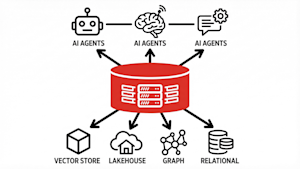
Enterprise data teams moving agentic AI into production are hitting a consistent failure point at the data tier. Agents built across a vector store, a relational database, a graph store and a lakehouse require sync pipelines to keep context current. Under production load, that context goes […]
Header Banner: Gabriel García Márquez, (born March 6, 1927, Aracataca, Colombia—died April 17, 2014, Mexico City, Mexico), Colombian novelist and one of the greatest writers of the 20th century, who was awarded the Nobel Prize for Literature in 1982, mostly for his masterpiece Cien años de soledad (1967; One Hundred Years of Solitude). He was the fourth Latin American to be so honoured, having been preceded by Chilean poets Gabriela Mistral in 1945 and Pablo Neruda in 1971 and by Guatemalan novelist Miguel Ángel Asturias in 1967. With Jorge Luis Borges, García Márquez is the best-known Latin American writer in history. In addition to his masterly approach to the novel, he was a superb crafter of short stories and an accomplished journalist. In both his shorter and longer fictions, García Márquez achieved the rare feat of being accessible to the common reader while satisfying the most demanding of sophisticated critics.